if there was ever a 8th wonder, it would be investing!

The AI Gold Rush in Banking
The AI Gold Rush in Banking explores how financial institutions worldwide are using AI to transform customer experience, strengthen fraud detection, and automate compliance. From hyper‑personalized services to intelligent risk management, discover how banks in India and beyond are redefining trust, efficiency, and innovation in finance.
Archit G. Gupta
5/29/20262 min read
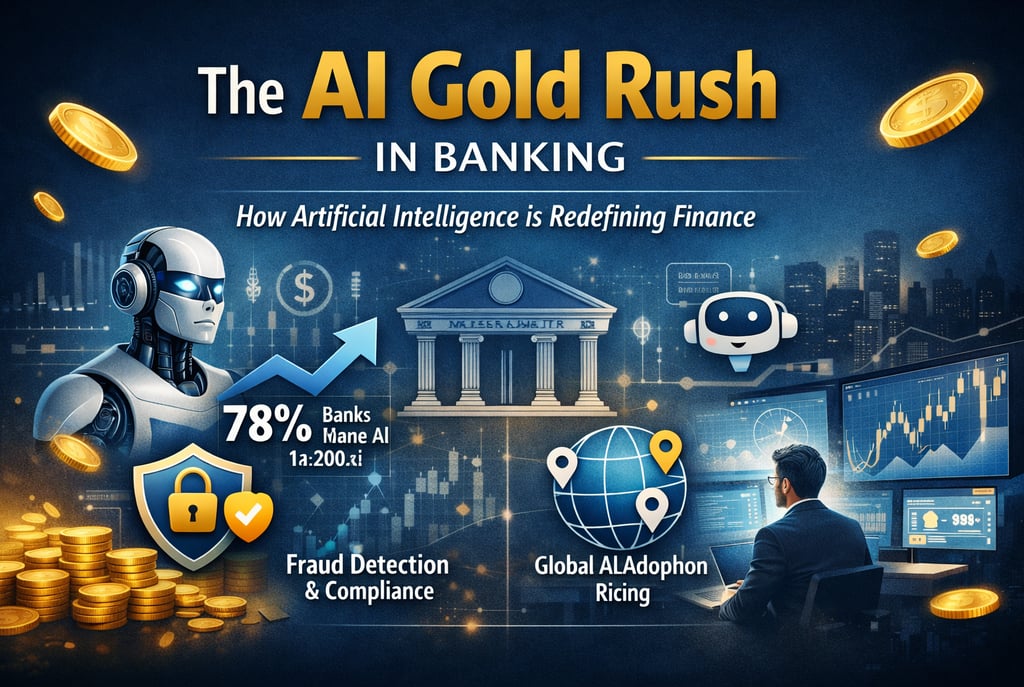
The AI Gold Rush in Banking: How Artificial Intelligence is Redefining Finance
From hype to reality, Artificial intelligence (AI) has moved the financial services industry. What began as chatbots and predictive models has evolved into a structural transformation of banking, wealth management, insurance, and payments. From customer experience to risk management, AI is reshaping the very foundations of finance—and the stakes couldn’t be higher.
🚀 Adoption at Scale
In 2017, only 20% of banks reported using AI. By 2024, that number had skyrocketed to nearly 80%, with boardrooms across the globe approving generative AI programs. Banking is now the second‑largest industry for AI spending, with investments exceeding $30 billion annually. India, in particular, has emerged as a leader, with more than half of enterprises actively deploying AI and a majority of adults experimenting with generative AI tools.
This rapid adoption reflects a recognition that AI is not just a technological upgrade—it is a competitive necessity.
💡 Transforming Customer Experience
AI is revolutionizing how banks interact with customers. Five areas stand out:
Personalization: Predictive analytics and generative AI deliver hyper‑tailored financial advice, offers, and notifications. Digital‑only banks like Revolut and Nubank have scaled rapidly by embedding personalization into every interaction.
Self‑Service: Virtual assistants such as Bank of America’s Erica and NatWest’s Cora handle millions of conversations, reducing reliance on branches and call centers.
Engagement: AI boosts digital adoption, with billions of interactions now occurring through apps and chatbots.
Automation: Routine support tasks are streamlined, cutting costs by up to 30% in some institutions.
Accessibility: AI interfaces make banking more inclusive, enabling diverse customer groups to manage finances independently.
The result is a banking experience that is faster, more intuitive, and increasingly personalized.
🔐 Risk, Security, and Compliance
Beyond customer service, AI is strengthening the backbone of financial systems:
Fraud Detection: Real‑time monitoring identifies suspicious activity before losses occur.
Credit Scoring: AI models assess borrowers more accurately, even those with limited credit histories.
Compliance: Automated systems interpret complex regulations and flag potential violations.
Cybersecurity: AI plays a dual role—expanding the attack surface but also defending against evolving threats with adaptive detection and response.
Yet, challenges remain. Algorithmic bias can perpetuate discrimination in lending. Overreliance on AI models may amplify systemic risks if they fail simultaneously. Regulators in the U.S., U.K., and Europe are demanding transparency, explainability, and ethical safeguards.
🌍 Regional Perspectives
United States: Major banks are investing billions in AI infrastructure and talent. JPMorgan, Goldman Sachs, and Morgan Stanley have deployed AI assistants for fraud detection, compliance, and investment research.
United Kingdom: Adoption doubled in 2024, with nearly all banks using AI for fraud prevention and process optimization. Regulators are closely monitoring developments.
India: Leading globally in adoption, Indian banks are leveraging AI for customer service, personalization, and fraud detection, supported by national AI strategies and cultural receptiveness.
🔮 The Road Ahead
The future of AI in banking points toward:
Hyper‑personalized financial advisors powered by generative AI.
Autonomous workflows that handle compliance, lending, and investment seamlessly.
Ethical AI frameworks ensuring fairness, transparency, and inclusivity.
Embedded finance ecosystems where AI integrates banking into everyday digital experiences.
EY’s $1.4 billion investment in its EY.ai platform underscores the scale of transformation underway. As AI becomes embedded across every function, banks must balance innovation with responsibility.
⚖️ Conclusion
AI is no longer optional—it is the catalyst for the next era of finance. The institutions that succeed will be those that harness AI to deliver efficiency, personalization, and trust, while navigating the risks of bias, regulation, and cybersecurity. For customers, this means a future where banking is not just digital, but intelligent.
✨ That’s the Finotopia perspective: AI is redefining finance, and the gold rush is well underway.